
Resin Driveway vs. Block Paving: A Head‑to‑Head Battle for Your Home in 2026
If you’re planning a new driveway, you’re probably stuck between two options: resin bound and block paving. Both are popular, but they are not equal – especially if you already have concrete or tarmac in place. In this guide we’ll compare resin and block paving on the things that matter most: Cost now and over the next 10–20 years Installation time and disruption Maintenance and long‑term appearance Drainage, SuDS and planning permission Safety and everyday use By the end, you’ll know exactly which surface makes more sense for your home – and why more and more homeowners are choosing resin bound with Perm‑Drive.
Kam Sefer
11/26/20254 min read
1. Cost: what you pay now and what you’ll pay later
Block paving
Needs full groundwork on most jobs: dig‑out, skips, sub‑base, sand bed, laying, cutting and compacting blocks.
Labour‑heavy and time‑consuming – you pay for a lot of hours.
Over time, joints can move, sand washes out, and you may need re‑sanding, cleaning and sealing.
Resin bound (especially as an overlay)
When you already have a sound concrete or tarmac base, we can often reuse it as an overlay.
That means:
No full excavation
No skips full of rubble
Less labour, fewer days on site
At Perm‑Drive, resin overlays on suitable bases typically fall in the £50–£80 per m² range, with many domestic driveways done in one day.
Verdict: If your base is good, resin bound overlay usually beats block paving on upfront cost and long‑term value.
2. Installation speed and disruption
Block paving
Multiple stages: excavation, disposal, sub‑base, levels, sand, laying, cutting, compacting, jointing.
Several days (or more) of noise, dust and limited access to your property.
Bad weather can slow everything down.
Resin bound with Perm‑Drive
For overlays, the process is streamlined:
Free on‑site survey and quote
Surface preparation and local repairs
Edging where needed
Resin/aggregate mixing and trowelling
Many domestic driveways are completed in a single day, with vehicle use typically after 24–48 hours (depending on temperature).
Verdict: Resin wins on speed and disruption. If you hate the idea of a building site outside your front door for days, resin is the clear choice.
3. Maintenance: how much work do you really want?
Block paving
Joints can host weeds, moss and ants.
Sand in joints washes out and needs topping up.
To keep it looking fresh, many homeowners pay for periodic cleaning, re‑sand and sealing.
Individual blocks can sink or move over time if the base or jointing fails.
Resin bound
No loose joints or sand beds.
Weed growth is massively reduced – nothing for roots to anchor in.
A simple routine is enough:
Light jet‑wash and soft brush
Treat algae in shaded areas
Remove oil/leaf stains early
No re‑sanding cycles, no “block by block” repairs in most cases.
Verdict: If you want low maintenance and long‑lasting kerb appeal, resin bound is the winner.
4. Drainage, SuDS and planning permission
This is where resin really shines.
Block paving
There are special permeable block systems, but many standard block installations are essentially impermeable unless built with specific sub‑bases and drainage details.
If water runs off to the road or neighbouring properties, you may run into planning and SuDS issues for front gardens.
Resin bound
A properly installed resin bound system is permeable: water drains through the surface into the base.
Installed to SuDS best practice, this often means:
No planning permission required for front‑garden driveways
Less standing water and surface runoff
Safer in winter – fewer big icy puddles
At Perm‑Drive, we carry out a free drainage assessment during your survey and design the simplest compliant solution.
Verdict: For most UK homes in 2025, resin bound is the easiest route to a beautiful, SuDS‑friendly driveway without planning headaches.
5. Everyday use: comfort, safety and noise
Block paving
Can be slightly uneven underfoot if not perfectly laid or if it moves over time.
Joints can trap dirt, moss and ice.
Vehicle tyres and prams can “rumble” over some patterns.
Resin bound
Smooth but grippy surface – comfortable for people, pets and tyres.
No loose stones like gravel, no stepped joints like block.
Excellent anti‑slip performance when installed to spec; we can add extra grip for slopes.
Easy to sweep and wash.
Verdict: Resin is typically quieter, smoother and safer day‑to‑day.
6. Aesthetics and kerb appeal
Both surfaces can look great – but in different ways.
Block paving
Traditional, patterned look.
Wide choice of blocks, but joints can quickly spoil the effect if maintenance slips.
Resin bound
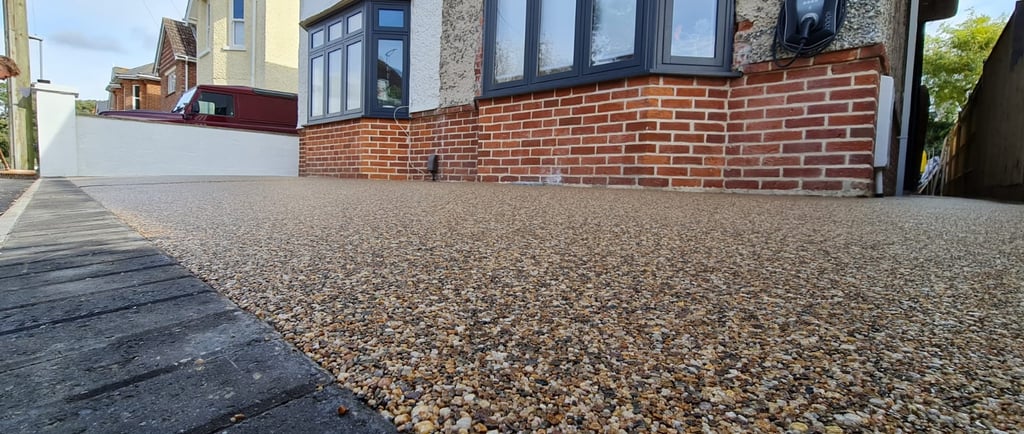
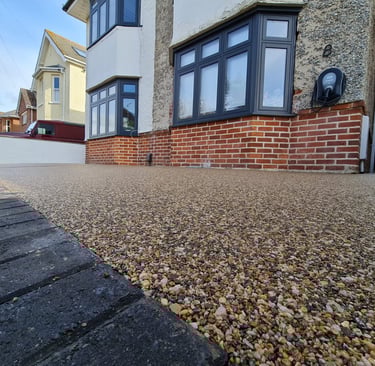
Modern, seamless finish that instantly updates the front of your home.
Dozens of natural stone blends:
Warm ambers for traditional brickwork
Cool greys and granites for modern renders
Contrasting borders to frame the driveway
Works brilliantly with matching paths and steps for a cohesive, “designed” feel.
Verdict: If you want a clean, contemporary look that stays sharp with minimal effort, resin bound feels like a premium upgrade.
7. What if my base isn’t good enough for an overlay?
Sometimes the honest answer is: the base must be fixed first.
If your existing concrete or tarmac is badly cracked, moving, or holding water, we may recommend:
Localised repairs and strengthening, or
A full permeable concrete foundation that drains and supports the surface long term.
Permeable concrete from Perm‑Drive is often a better choice than tarmac for rebuilding bases – it handles heat cycles better and works with SuDS, not against it.
You’ll always get our honest opinion in writing, with options and prices laid out clearly.
8. So, which should you choose?
If you value:
A premium look
Fast installation with minimal disruption
Lower maintenance over the next 10–20 years
Simpler SuDS compliance and fewer planning headaches
…then a resin bound driveway – especially as an overlay on existing concrete or tarmac – is very hard to beat.
Block paving still has its place, but for most of our customers in Skelmersdale, Wigan, St Helens, Ormskirk and surrounding areas, resin bound offers better value, better performance and a cleaner, more modern result.
9. The Perm‑Drive advantage
When you choose Perm‑Drive, you get:
Local, family‑run service – easy to reach, easy to talk to
Free on‑site survey with honest advice
Same‑day or next‑day written quote
Overlays from £50–£80 per m² on suitable bases
Installations often completed in one day
Work carried out to SuDS best practice
A 20‑year written workmanship guarantee
We don’t just sell you a surface. We help you choose the smartest solution for your home and budget.
10. Ready to compare resin to your current driveway?
If you’ve got concrete or tarmac already down, you may be much closer to a stunning new driveway than you think.
Call or WhatsApp: 0161 399 0875
Quick form: https://perm-drive.co.uk/#quote
Book your free on‑site survey today. We’ll:
Check whether your base is suitable for a resin overlay
Explain your options vs block paving in plain English
Give you a clear, itemised quote – with no pressure
If you book your survey before 31 December, you can also secure up to 20% off 2025 installation dates (subject to availability).
Upgrade once. Enjoy every day.
FAQ
1. How Long Do Resin Driveways Last?
Resin driveways are built to last. With proper care, your driveway can stay pristine for 25+ years. Unlike concrete, resin doesn’t crack or loosen, so you’ll never deal with weeds or stray stones. At Permeable Driveways, we back our work with a 20-year guarantee – because your peace of mind matters.
2. How Much Does a Resin Driveway Cost?
Every project is unique, but here’s a ballpark:
20m² Driveway: from £65 per m²
50m² Driveway: £55–£120 per m²
100m² Driveway: £45–£100 per m²
Exact pricing depends on size, location, and design.
No Guesswork: Book a free site visit, and we’ll measure your space, discuss your options, and provide a fixed quote.
3. How Do You Clean a Resin Driveway?
Resin driveways are famously low-maintenance, but a little care goes a long way:
Weekly: Sweep with a stiff outdoor brush to remove debris and prevent moss.
Deep Clean: Use a jet washer (<150bar pressure) for stubborn dirt.
Jet Washing Tips:
Sweep first to remove loose debris.
Use mild water temperature (no extremes).
Hold the nozzle 20cm away and spray in sweeping motions.
Test detergents on a small area first.
Pro Tip: Avoid high-pressure or harsh chemicals to keep your driveway looking new.
4. How Are Resin Driveways Installed?
Our 4-step process ensures a flawless, long-lasting finish:
1. Preparation
We assess your existing driveway and excavate if needed.
A stable, porous sub-base is created using 175mm of compacted hardcore and 60-70mm of permeable concrete or tarmac.
2. Grid System (If Needed)
For added stability and drainage, we install an innovative grid system.
The grid is filled with gravel to create a porous layer that prevents puddles.
3. Resin Application
Our team hand-trowels a custom resin mixture for a smooth, even finish.
Every detail is crafted with precision to match your design.
4. Final Touches
Once cured, your driveway is ready to use – no waiting weeks like concrete.
© 2025. All rights reserved.