
SuDS Law Made Simple: Do You Need Planning Permission for a New Driveway in 2025?
Thinking about upgrading your driveway but worried about planning permission? Good news: if you choose a permeable surface like resin bound or permeable concrete, you can often avoid formal planning consent entirely. This plain‑English guide explains SuDS, shows when permission is needed, and helps you pick the smartest, most economical option for your home. Quick answer: Permeable resin bound driveways installed to SuDS best practice usually do not require planning permission for front gardens in England. Bonus: With a sound concrete or tarmac base, a resin overlay can cost just 50–80 GBP/m² and be installed in as little as a day.
Mark Aterby
10/28/20253 min read
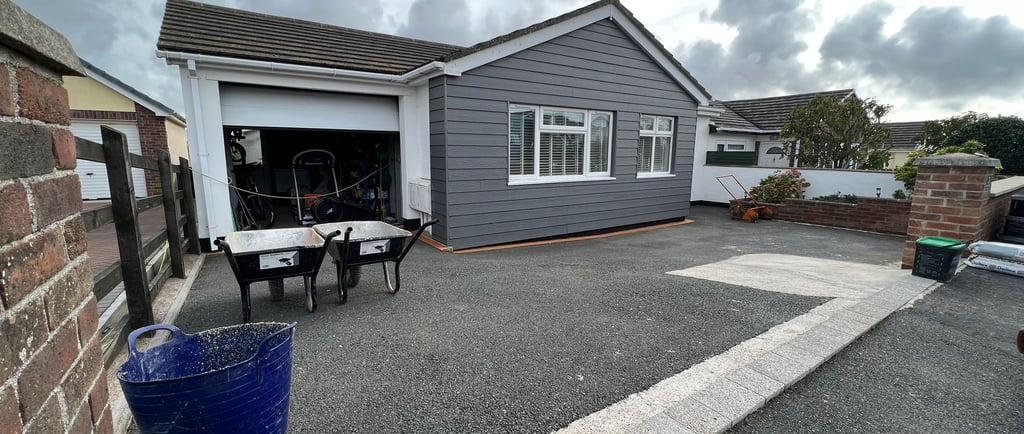
What is SuDS and why does it matter?
SuDS stands for Sustainable Drainage Systems. The goal is simple: help rainwater soak away naturally rather than flooding streets and sewers. Surfaces that allow water to drain through—like resin bound laid on a suitable base or permeable concrete—are SuDS‑friendly. Impermeable surfaces (solid concrete or tight tarmac without drainage) push water elsewhere and can trigger permission requirements.
In practice, SuDS affects two things:
Whether you need planning permission
Whether your driveway stays free of puddles and winter ice sheets
When you usually don’t need planning permission
You choose a permeable surface (resin bound, permeable concrete, or permeable block systems).
Runoff is not directed to the road or onto neighbouring land.
Any new hard surface on the front garden is designed so water drains into the ground within your property (e.g., via permeable surface, a soakaway, or French drain).
Resin bound is one of the easiest paths to compliance: the surface itself is permeable, looks premium, resists weeds, and needs very little maintenance.
When you may need permission or extra drainage design
You propose an impermeable surface (traditional concrete or tarmac) with runoff toward the highway.
The site has unusual ground conditions (very heavy clay with nowhere for water to go).
You want significant level changes, walls, or works around a listed building or in a conservation area.
Large commercial or multi‑unit projects—different rules apply.
If we spot any of these during survey, we’ll map out the simplest compliant fix: local soakaway, channel drain to a permeable zone, or switching to a permeable system.
Resin bound vs. other “permeable” options
Resin bound
Seamless, contemporary look; dozens of stone blends
Permeable surface, anti‑slip, low maintenance
Often installable as an overlay on sound concrete/tarmac = 50–80 GBP/m², 1‑day fit
Permeable concrete
Robust, drains through the slab
Excellent as a long‑life base where the existing one is failing
Can be finished with resin now or later
Permeable block paving
Works well when designed correctly, but joint upkeep and longer build make it pricier and fussier than a resin overlay for many homes
The 7‑minute homeowner checklist
Use this before you plan works (we’ll verify everything on site):
Which surface? Choose a permeable system to simplify compliance.
Existing base sound? If yes, ask about a resin overlay to save time and money.
Where does water go? Ensure falls direct water to permeable zones, not the road.
Edging and boundaries? Define crisp edges to contain the surface.
Driveway use? Number of vehicles, occasional van—affects layer thickness.
Access routes? Check clear paths for materials and mixing.
Local constraints? Conservation areas/listed buildings may add steps—ask us.
Costs: honest ranges for 2025
For a suitable overlay on sound concrete or tarmac:
Typical price: 50–80 GBP/m²
Many domestic driveways complete in one day
Itemised quote after survey (repairs, edging, colour blend, access)
If the base is unsuitable, our permeable concrete solution creates a long‑life, SuDS‑friendly foundation that outperforms tarmac on heat and rutting—then you can add resin for a premium finish.
Design: make SuDS beautiful
Colour palettes: warm ambers, cool granites, sleek charcoals
Feature borders: subtle contrast bands to frame entrances
Gentle falls: designed for both drainage and comfort
Accessibility: graded anti‑slip for slopes and mobility
Bring a photo of your frontage; we’ll match blends and borders in natural light during your survey.
Installation—what to expect with Perm‑Drive
Free on‑site survey and drainage assessment
Same‑day or next‑day written quote
Prep: clean, key, local repairs; install edges
Lay resin bound (18–24 mm typical) with continuous mixing and trowelling
Fast cure: walk on in hours; cars usually 24–48 h
Handover: care guide + 20‑year written workmanship guarantee
Our prep‑first approach delivers longevity and that sharp, seamless finish people notice from the kerb.
FAQs
Do permeable driveways really need no permission?
Often no—when installed to SuDS best practice. We confirm specifics on your property.Will resin stay non‑slip?
Yes, resin bound has excellent skid resistance to spec; we can add extra grip on slopes.Can you fix minor base cracks first?
Absolutely. We repair and bridge hairline issues; structural movement requires a base solution.How do I maintain it?
Light jet‑wash and soft brushing. Remove stains quickly. Avoid metal‑edged shovels.
Limited‑time offer—save more and keep it compliant
Book your free survey before 31 December to secure up to 20% off 2025 installation dates. We’ll check SuDS compliance, confirm if a budget‑friendly overlay will work, and give you a fixed, written quote.
Call/WhatsApp: 0161 399 0875
60‑second form: https://perm-drive.co.uk/#quote
Upgrade the smart way—premium look, SuDS‑friendly performance, minimal disruption.
Meta pack for this article (optional, for your CMS)
Focus keyword: SuDS driveway planning permission
SEO title: SuDS Driveways 2025: Do You Need Planning Permission? | Perm‑Drive
Meta description: Do you need planning permission for a new driveway? Our 2025 SuDS guide explains when resin bound and permeable concrete avoid consent—plus prices and a year‑end discount.
Suggested slug: suds-driveway-planning-permission
FAQ
1. How Long Do Resin Driveways Last?
Resin driveways are built to last. With proper care, your driveway can stay pristine for 25+ years. Unlike concrete, resin doesn’t crack or loosen, so you’ll never deal with weeds or stray stones. At Permeable Driveways, we back our work with a 20-year guarantee – because your peace of mind matters.
2. How Much Does a Resin Driveway Cost?
Every project is unique, but here’s a ballpark:
20m² Driveway: from £65 per m²
50m² Driveway: £55–£120 per m²
100m² Driveway: £45–£100 per m²
Exact pricing depends on size, location, and design.
No Guesswork: Book a free site visit, and we’ll measure your space, discuss your options, and provide a fixed quote.
3. How Do You Clean a Resin Driveway?
Resin driveways are famously low-maintenance, but a little care goes a long way:
Weekly: Sweep with a stiff outdoor brush to remove debris and prevent moss.
Deep Clean: Use a jet washer (<150bar pressure) for stubborn dirt.
Jet Washing Tips:
Sweep first to remove loose debris.
Use mild water temperature (no extremes).
Hold the nozzle 20cm away and spray in sweeping motions.
Test detergents on a small area first.
Pro Tip: Avoid high-pressure or harsh chemicals to keep your driveway looking new.
4. How Are Resin Driveways Installed?
Our 4-step process ensures a flawless, long-lasting finish:
1. Preparation
We assess your existing driveway and excavate if needed.
A stable, porous sub-base is created using 175mm of compacted hardcore and 60-70mm of permeable concrete or tarmac.
2. Grid System (If Needed)
For added stability and drainage, we install an innovative grid system.
The grid is filled with gravel to create a porous layer that prevents puddles.
3. Resin Application
Our team hand-trowels a custom resin mixture for a smooth, even finish.
Every detail is crafted with precision to match your design.
4. Final Touches
Once cured, your driveway is ready to use – no waiting weeks like concrete.
© 2025. All rights reserved.